Fit the operation
Your terminology, workflows, rules, customer requirements, roles and exceptions belong in the system — not in a spreadsheet sitting beside it.
Adaptive business software
Most companies are forced to choose. Buy a package and reshape the operation around the software. Or build something custom that fits today, then pay for every change tomorrow.
Smart Info Technologies is built to break that trade-off. We shape the system around your processes, terminology, rules, roles and integrations — while keeping what is specific to you separate from the platform we continue to improve.
Software that fits how you work. And keeps fitting.
Operating since 2007 · Framework in production since 2014 · Current generation shipped in 2026
The trade-off we eliminate
You should not have to choose between software that fits the operation and software that can keep evolving. The point of our architecture is to give you both.
Your terminology, workflows, rules, customer requirements, roles and exceptions belong in the system — not in a spreadsheet sitting beside it.
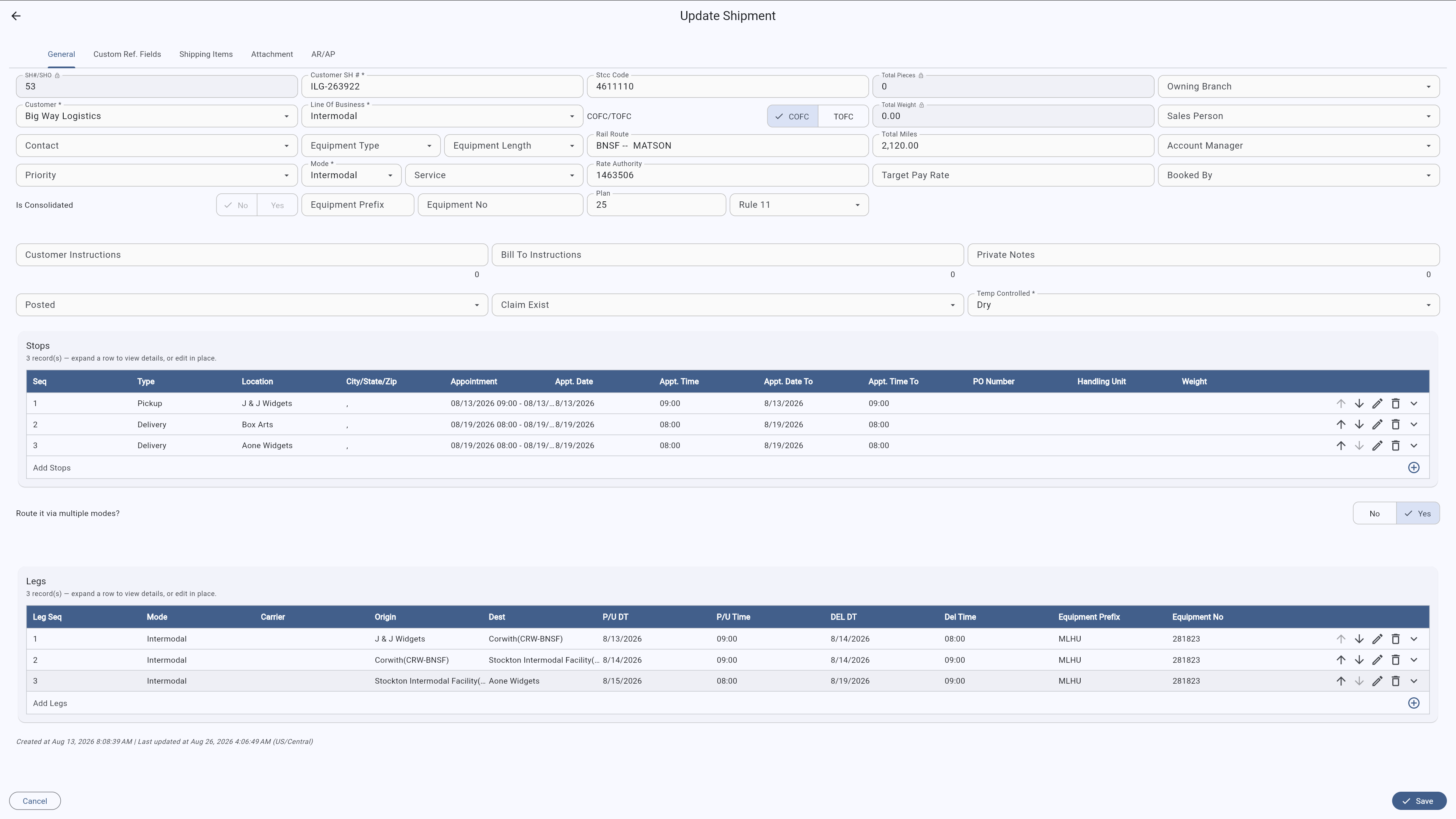
When a process, role, rule or partner requirement changes, supported changes are made to the business description rather than starting another custom development cycle.
What is specific to you stays separate from the shared platform underneath. We can keep improving the platform without turning your fit into a frozen custom version.
What ships on day one
Every application starts with the parts that usually take a project its first six months.
Who can see and do what is part of the description, and the system enforces it on every single request.
Sign-in runs on Google Firebase. We hold no passwords. MFA available.
Each organisation's data is kept separate by the framework itself, not by everyone remembering to be careful.
One description, all three. Nothing is built separately for mobile, so nothing can fall behind.
Multi-column sorting and grouping handle most day-to-day analysis without exporting anything.
Pie, bar and line views of any grouping, drawn from the same screen definition.
Complex criteria with AND / OR conditions, on any entity, without a report request.
Define mappings to trade data with the outside world over EDI, XML and API.
Answers without a report request
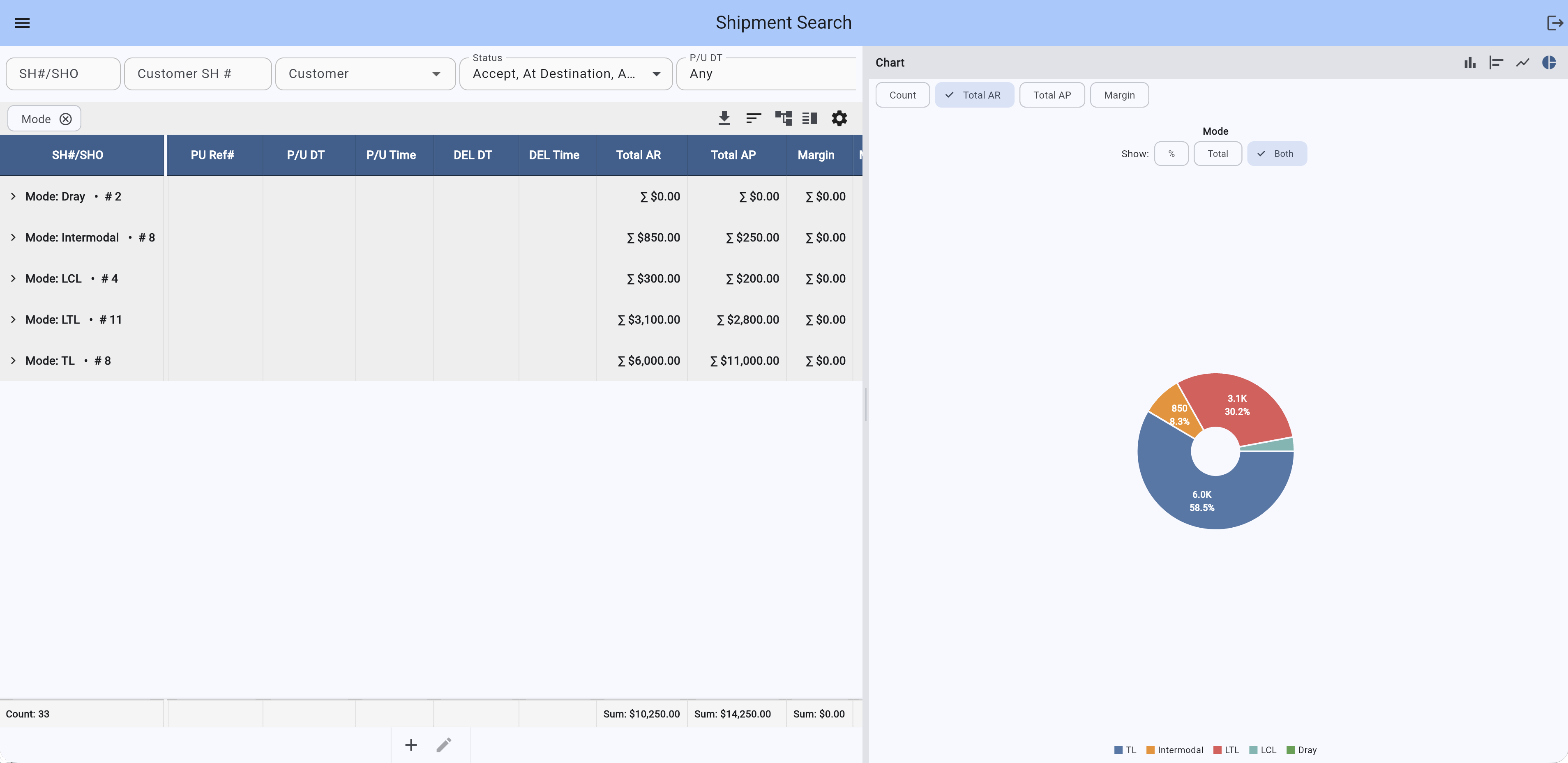
In most systems, "group these shipments by mode and show me the revenue split" is a request that goes to IT and comes back next week as a report. Here it is something a dispatcher does in the grid, in about four seconds, on any column.
Group by anything. The totals calculate themselves. Turn on the chart and it draws from whatever grouping is on screen, switching between count, revenue, cost and margin as you click. Nobody configured this view, and no developer was involved in making it exist — it comes with every screen on the framework, on every field, for free.
Avoiding the custom-version dead end
The real question is not whether software can be configured. It is what happens after it has been configured heavily. Does every future improvement threaten what was built for you?
We keep the shared platform and your operating model separate. Your fields, wording, screens, rules, roles and partner connections live in their own layer over the common foundation. That is what lets the system fit deeply without requiring a separate customer fork.
The foundation every customer starts from and the part we keep improving. We are not maintaining a separate product branch for every account.
Your fields, terminology, screens, rules, customer requirements and partner connections. They can be shaped around the operation without being carved into the common platform.
A dispatcher, manager and controller can use the same system with different working views and permissions. Access is enforced by the platform, not merely hidden in the interface.
Configured heavily. Upgraded anyway. The business value is simple: fit today should not become technical debt tomorrow.
The technical detail — base objects, customer layers, role layers and the boundaries of the model — is documented on the How it works page.
Built for the AI era
AI can understand requirements, interpret documents, propose changes and increasingly take action across workflows. That makes a second question more important: what is the AI actually allowed to do?
A real operation has customers, orders, approvals, calculations, exceptions, permissions and connections to other systems. Those boundaries cannot live only in a prompt. Our framework already represents much of that operating model in a structured form and enforces it when the system runs.
| AI can help with | The operating model governs | |
|---|---|---|
| Requirements | Interpret conversations and documents | Which business objects, fields and rules are valid |
| Change | Propose definitions, mappings and tests | What structure is accepted and what must be approved |
| Operations | Recommend or automate work | Roles, permissions, approvals and allowed actions |
| Integration | Understand partner formats | Known mappings, contracts and system boundaries |
| Accountability | Accelerate people and processes | Deterministic execution and the system of record |
AI understands intent. Your business model defines the boundaries. The framework executes them.
Today we use AI where it earns its place — helping draft definitions from requirements, mapping partner formats, creating test data and documentation, and supporting analysis over structured operational data. We do not need probabilistic AI to decide whether a core permission, business rule or financial calculation is valid.
AI-generated software can also be useful. Our distinction is not that code cannot be tested or governed; it can. The point is that faster code creation does not make the production lifecycle disappear. SIT reduces how much application-specific code has to exist in the first place.
How we work
Complex operational software changes faster when the business problem is not filtered through layers of account management. The team responsible for the platform stays close to the people using it.
The person you explain the problem to stays close to the person who can change the system.
Proof
The architecture has been running production operations since 2014. The current generation shipped in 2026. These products show the same platform supporting very different operating models.
Our own SaaS TMS for freight brokers, forwarders, 3PLs, agency networks and shippers. Order to financial settlement in one system, with EDI, XML and API links to every trading partner. smartscm.com →
Three configured variants of an equipment tracking, inspection and certification platform for a single customer — same framework, three different operating models.
An RFID-driven VMI platform where tag reads at the point of use drive replenishment, usage reporting and billing.
Customer names available under NDA. In every case the customer owns their process, configuration, data and custom development; SIT owns the framework.
As a small company competing in a land of giants, our value proposition depended on working smarter. This required an IT partner that could share our vision and deliver to our requirements. SmartSCM has done that since 2012.Theodore PrinceChief Strategy Officer and Co-founder, Tiger Cool Express LLC
SmartSCM is not an ordinary TMS. It is a one of a kind, ever evolving program customised to our unique business model — managing multiple modes of transportation and warehouse distribution in one place. It has been essential to our success since 2009.Shawn GotschallOwner, RE Transportation, Inc.
Security
We publish the technical detail up front and can support vendor security reviews as the conversation progresses. Where a control belongs to Google rather than to us, we say so.
A workflow, exception, customer requirement or integration that forces workarounds today. That is a better starting point than a generic feature tour.